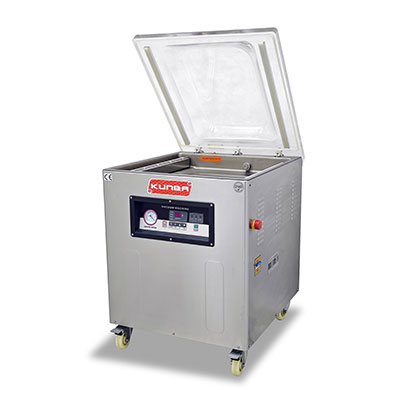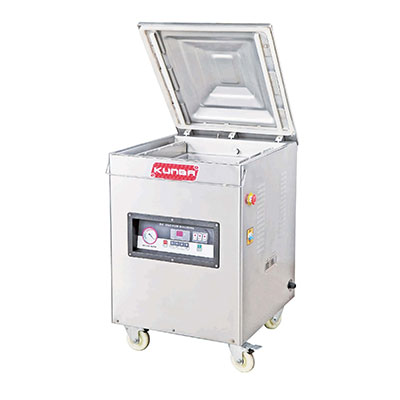
In a busy food packaging facility, every second counts. Yet, one of the most overlooked bottlenecks in vacuum packaging isn’t the vacuum pump—it’s the operator. For workers using standard equipment, the physical act of opening and closing a heavy chamber lid can consume up to 20% of their total cycle time. Beyond the lost seconds, inconsistent manual pressure often leads to uneven seal bars, resulting in rejected packs and wasted food.
This analysis quantifies the operational gap between automatic and semi-automatic food vacuum packing machine designs. We move beyond the brochure specs to provide a rigorous examination of labor costs, Return on Investment (ROI), and consistency. For the production manager or factory owner, the core question is not just which machine is faster, but whether the automation upgrade actually pays for itself in saved labor and reduced waste.
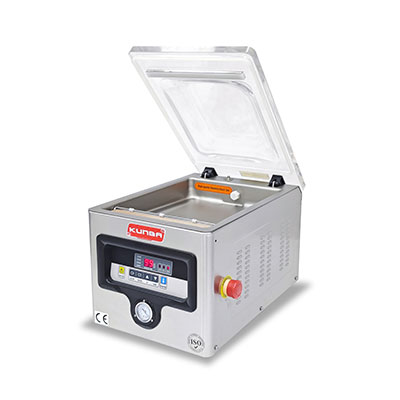
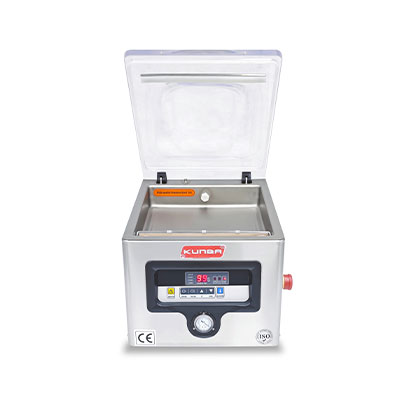
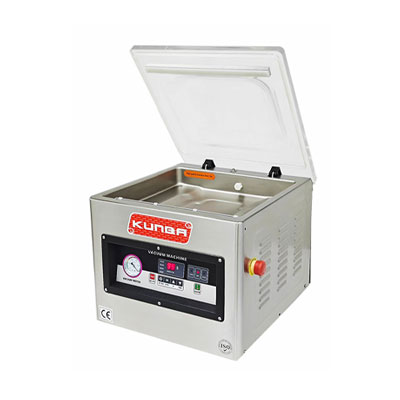
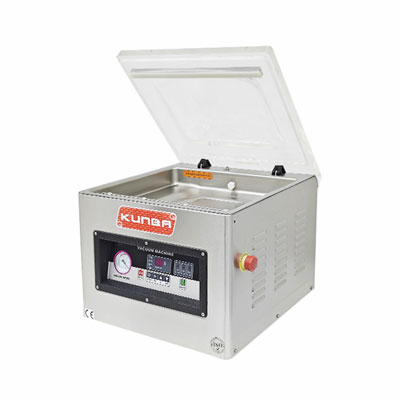
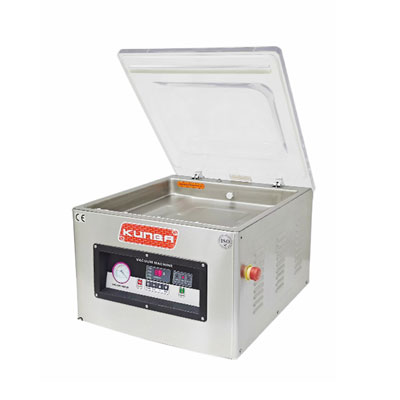
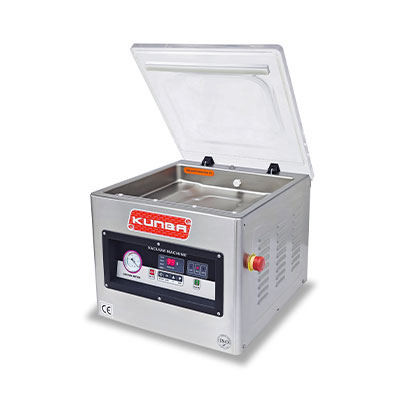
The industry standard for small to medium-sized operations is the semi-automatic chamber machine. In this configuration, the machine handles the brain (vacuum and seal cycle) but relies on the operator for the brawn.
Operation: After placing the product bags across the sealing bar, the operator physically grabs the lid, pulls it down, and often locks it into place via latches or the natural pressure of the gas springs.
Cycle execution: The operator presses a start button or a foot pedal-operated vacuum packer to initiate the cycle.
Completion: Once the vacuum drops and the seal bar heats, the chamber releases the vacuum. The operator must manually lift the heavy lid to remove the product.
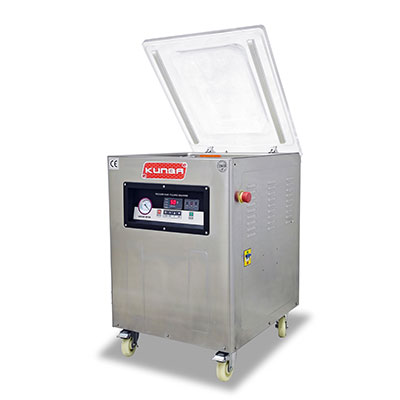
The automatic vs semi-automatic food vacuum packing machines become stark when introducing pneumatic automation. An automatic machine, often called a pneumatic chamber sealer, replaces human muscle with compressed air cylinders.
Operation: The operator loads the product and presses a single start button (or foot pedal).
Automation: A signal is sent to a solenoid valve, allowing compressed air to enter the cylinders, which smoothly and forcefully closes the lid.
Sealing: The machine runs the programmable vacuum packaging machine sequence (evacuation, gas flush if applicable, sealing, cooling).
Completion: The air cylinders reverse, lifting the heavy lid automatically. The operator simply removes the finished pack and reloads.
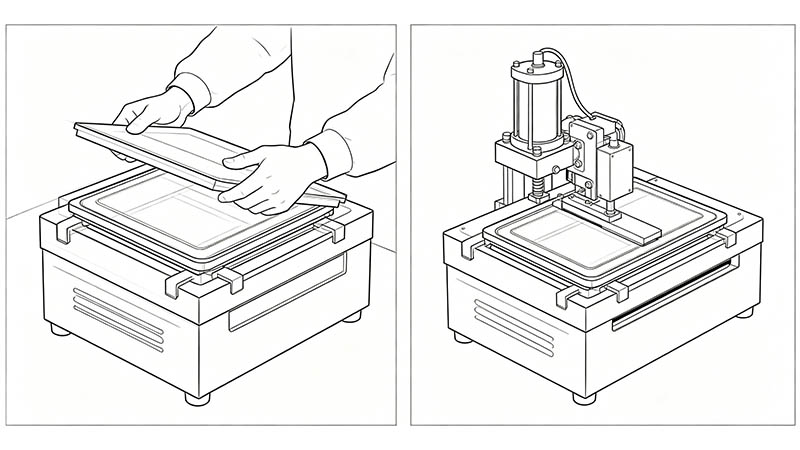
To understand the efficiency gains of a pneumatic chamber sealer, we must analyze the micro-motions of a standard 30-second cycle. While the vacuum pump’s runtime remains identical, the human interaction time varies significantly.
| Action | Semi-Automatic (Manual Lid) | Automatic (Pneumatic Lid) |
|---|---|---|
| Load Product | 5 seconds | 5 seconds |
| Close & Lock Lid | 4 seconds | 0 seconds (auto) |
| Evacuation & Seal | 25 seconds | 25 seconds |
| Unlock & Open Lid | 2 seconds | 0 seconds (auto) |
| Unload Product | 3 seconds | 3 seconds |
| Total Cycle Time | 39 Seconds | 33 Seconds |
Conclusion: Over the course of an 8-hour shift, those 6 saved seconds per cycle allow the automatic machine to complete significantly more cycles.
Let us translate the time savings into real-world currency. Assume a fully burdened labor cost of $18 per hour for the operator.
Semi-Automatic (Manual): At 39 seconds per cycle, the machine produces approximately 92 cycles per hour. (3600 seconds / 39 seconds).
Automatic (Pneumatic): At 33 seconds per cycle, the machine produces approximately 109 cycles per hour.
The Daily Difference:
Over an 8-hour shift, the automatic machine runs an additional 136 cycles. If each cycle contains 2 bags, that is an extra 272 units of finished product processed by the end of the day without paying a cent in overtime.
From a labor perspective, the automatic machine effectively creates "free" labor. To match the output of the automatic machine, a semi-automatic user would need to pay for roughly 1.5 hours of overtime per day. That equates to $24.5 of saved labor value per day.
ROI Calculation: If the upgrade to a labor-saving vacuum sealer costs 3,000,andyousave3,000,andyousave24.5/day, the equipment pays for itself in just 122 working days (roughly 6 months).
Efficiency is not just about speed; it is about reliability. In a semi-automatic environment, the quality of the seal is subject to the physical state of the human operator. A tired worker at 4:30 PM may not slam the lid down with the same force as they did at 8:00 AM.
The Physics of Manual Sealing: If the lid is not perfectly parallel to the sealing bar, pressure distributes unevenly. One side of the bag may seal perfectly, while the other side leaks (known as "channel leaks").
The Pneumatic Solution: An automatic machine powered by a programmable vacuum packaging machine logic uses a regulated compressed air supply. The downward pressure is mathematically consistent. Every cycle, the pressure on the seal bar is identical.
Industry data suggests that switching from manual lid closing to pneumatic closing reduces seal failure rates caused by operator fatigue by approximately 12%. For a factory producing 10,000 bags a day, that means 1,200 fewer reseals or re-packs—pure profit.
While the data favors automation, the automatic vs semi-automatic food vacuum packing machine decision is not universal. Semi-automatic (manual lid) machines remain the optimal solution for several scenarios:
1. Low Volume / High Mix Production
If your daily production is consistently below 500 bags, the ROI timeline for automation extends beyond two years. Furthermore, if you swap between drastically different pouch sizes or rigid trays multiple times per hour, the instant feedback of a manual lid can be faster than reprogramming pneumatic timings.
2. Budget Constraints
Capital expenditure is a reality. A pneumatic chamber sealer typically adds 1,500to1,500to3,000 to the upfront cost of the machine compared to a manual gear-driven lid.
3. Lack of Compressed Air Infrastructure
Automatic machines require a clean, dry compressed air supply (usually 60–80 PSI). If your facility does not have an air compressor capable of handling 2-3 CFM per cycle, the cost of adding that infrastructure may outweigh the labor benefits.
One of the most cost-effective strategies for a growing business is retrofitting. Many industrial-grade vacuum chamber machines are designed with modularity in mind. You do not always need to buy a brand-new labor-saving vacuum sealer.
The Retrofit Kit: Many manufacturers (including high-quality suppliers like KUNBA) offer pneumatic lid conversion kits. These include the cylinder, mounting brackets, solenoid valve, and tubing.
Installation: If your machine has a "compressed air input" port or spare relay inside the electrical panel, installation often takes less than 1 hour.
Cost vs. New: A retrofit typically costs 40-50% less than trading in the entire unit for a factory-built automatic model.
Verification: Check your current machine. If the lid hinge has bolt holes for a cylinder bracket, you can likely upgrade without welding or heavy fabrication.
Q: Does automatic mode require a compressed air connection?
A: Yes. Unlike semi-automatic machines that run on electricity alone, a pneumatic chamber sealer requires a stable compressed air source (typically 60-80 PSI). Do not factor this out of your installation costs.
Q: Is an automatic machine harder to maintain?
A: Marginally. While the base vacuum pump and seal bar maintenance are identical, the automatic machine introduces pneumatic cylinders and solenoid valves. However, these are off-the-shelf industrial components that are cheap to replace and rarely fail compared to mechanical linkages.
Q: Can I still manually operate an automatic machine?
A: Most modern automatic machines retain a "manual mode" in the programmable vacuum packaging machine controller. If the air compressor fails, you can often disable the pneumatic circuit and use the machine as a manual unit (though lifting the lid will be difficult due to the weight of the cylinders).
In the debate of automatic vs semi-automatic food vacuum packing machines, the decision matrix is defined by scale and budget.
For the factory owner prioritizing throughput per labor dollar and seal consistency, the automatic pneumatic chamber sealer is the superior tool. It removes physical fatigue from the quality equation and recaptures the "dead time" of lid handling, boosting output by roughly 15% per shift.
However, for the small-scale producer or R&D kitchen, the semi-automatic manual lid machine remains a valid, low-capital entry point. It requires no compressed air and offers full tactile control.
If the bottleneck in your line is the operator's arms, the solution is automation.
Contact KUNBA today to request a quote on our labor-saving vacuum sealer lineup. Ask us about retrofitting your current manual machine with our pneumatic/electric automatic lid kit to instantly boost your hourly output.

GET A QUOTE

 中文
中文 English
 Français
 Español
 Português