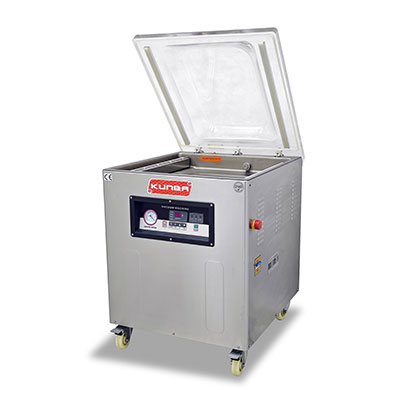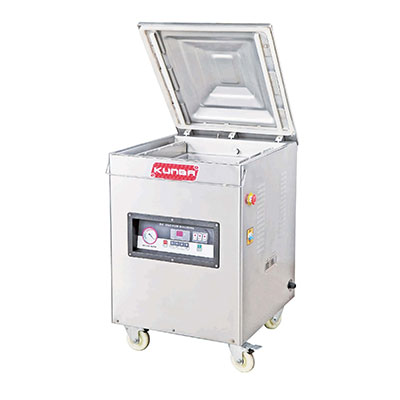
Buying the wrong vacuum packaging machine can silently drain your profits. You might see incomplete seals, find your machine repeatedly contaminated by leaking liquids, or watch your packaging line grind to a halt because the equipment simply can’t keep up. For restaurant owners, small food processors, and central kitchen operators, these problems translate directly into wasted product, frustrated staff, and rising operational costs.
The good news? The choice between a chamber vacuum packaging machine and an external vacuum sealer is not complicated once you understand how each technology works. This guide will walk you through the core differences in operation, liquid handling, production speed, bag costs, and investment requirements. By the end, you will know exactly which type of commercial vacuum sealer fits your business needs—and which one to avoid for certain applications.
Understanding the fundamental mechanism of each machine type is the first step toward making an informed decision. The difference in how air is removed determines virtually everything else about the machine’s capabilities and limitations.
External vacuum sealers—also called suction, edge, or nozzle sealers—operate by inserting the open end of a vacuum bag into the machine, where a nozzle extracts air directly from the bag before a heat strip seals it shut. Only the open end of the bag enters the machine; the rest of the bag and its contents remain outside the unit. This design makes external sealers compact and affordable, but it introduces a critical limitation: as the bag collapses around the product during vacuuming, any liquid present will be drawn toward the open end and sucked into the machine along with the air. Unless you plan to freeze your liquids first or take other special precautions, external vacuum sealers should be limited to dry and solid foods.
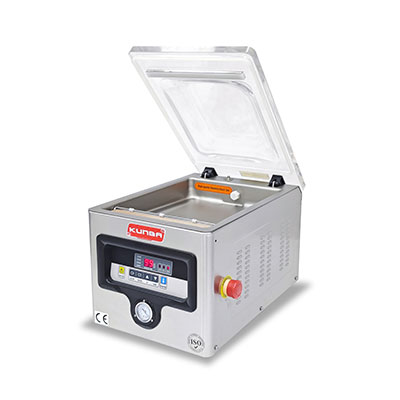
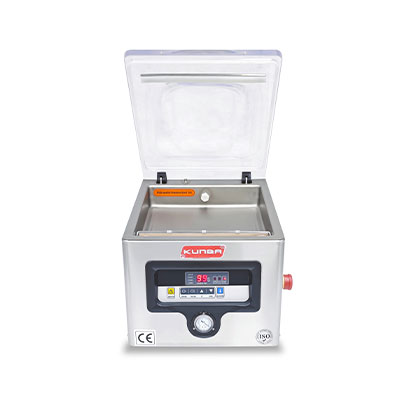
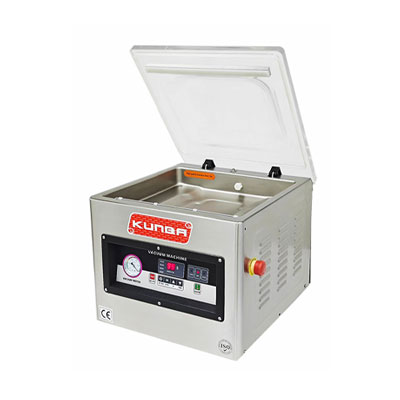
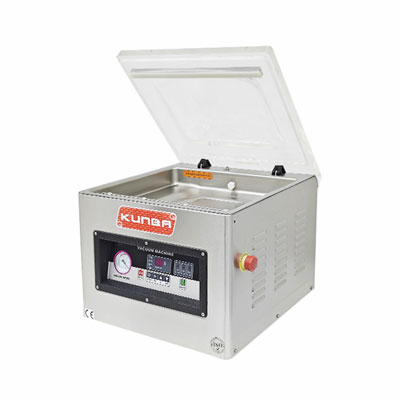
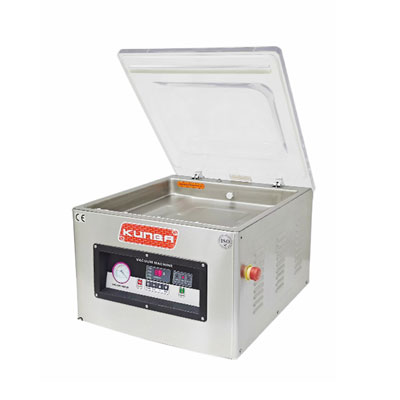
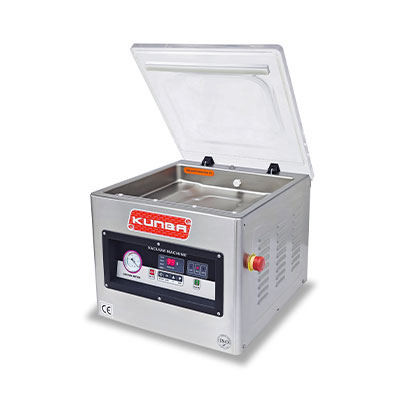
Chamber vacuum sealers work on a completely different principle. The entire product-filled bag is placed inside a sealed chamber, with the bag’s open end laid over a sealing bar. The machine then evacuates air from the entire chamber—including both the inside and outside of the bag simultaneously. Because the pressure inside and outside the bag remains equal throughout the process, liquids stay exactly where they belong: inside the bag. When the desired vacuum level is reached, the sealing bar activates, the bag is sealed, and the vacuum is released. This balanced-pressure design is what enables chamber sealers to handle soups, sauces, marinades, and other liquid-rich products with complete reliability.
If your business packages any product containing moisture, juice, marinade, or sauce, this single comparison may determine your entire decision.
Imagine you run a butcher shop and want to vacuum-seal marinated steaks. You place a steak with its marinade into an external sealer bag and start the cycle. As the machine pulls air from the bag, the bag collapses around the meat, squeezing the marinade toward the open end. The liquid is then sucked directly into the machine’s vacuum pump. The result: a contaminated machine, a failed seal that allows air back into the bag, and a messy cleanup. The same problem occurs with fresh meats that release natural juices, with seafood, with marinated vegetables, and with any product containing moisture.
Some manufacturers suggest freezing liquids before vacuum sealing as a workaround. But this adds hours to your production process, consumes valuable freezer space, and is simply not practical for high-volume commercial operations.
.webp)
With a chamber vacuum packaging machine, the same marinated steak presents no problem at all. Because the pressure inside and outside the bag equalizes as the chamber evacuates, liquids remain contained within the bag. The bag seals cleanly, the machine stays dry, and the process takes the same amount of time as sealing dry goods. Chamber machines can package soups, stews, sauces, and any wet food without any extra attachments or special preparation.
The bottom line: If your product list includes anything with liquid content—marinated meats, fresh fish, prepared meals with sauce, soups, or pickled products—a chamber vacuum sealer is not just the better choice; it is the only viable choice for reliable commercial packaging.
-1328.webp)
Beyond liquid handling, two operational factors significantly impact your bottom line: how many packages you can produce per hour, and how much you spend on each bag.
External vacuum sealers typically cycle in 30 seconds or longer per bag, depending on the model and product type. More importantly, they seal only one bag at a time, and an operator must manually monitor and reset the machine after each cycle.
Chamber vacuum sealers, by contrast, can seal multiple bags simultaneously in a single cycle. A typical chamber cycle takes 20 to 60 seconds depending on pump capacity and package size. But because several bags can be loaded together, the output per hour multiplies. Industrial chamber systems can achieve 800 to 1,200 sealed items per hour, outpacing traditional external sealers by roughly three times.
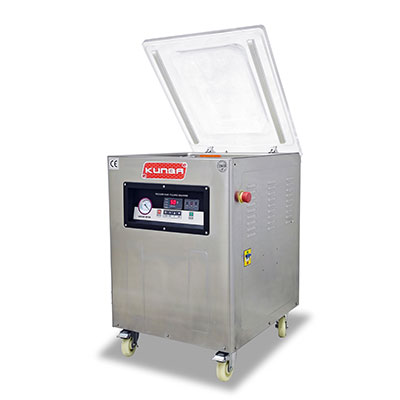
For businesses with moderate to high production volumes, double-chamber vacuum packing machines offer an even greater advantage. These systems feature two independent chambers, allowing one side to be loaded or unloaded while the other chamber is actively sealing, minimizing downtime and maximizing throughput.
This is where many buyers are caught off guard. External vacuum sealers require specially textured—or “embossed”—bags. The textured surface creates channels that allow air to be drawn out from the entire length of the bag. These bags are more expensive to manufacture due to the embossing process and the need for greater thickness to avoid punctures during production.
Chamber vacuum sealers, in contrast, use smooth (non-embossed) bags. Without the need for textured channels, these bags are significantly less expensive. According to industry sources, chamber vacuum pouches can cost up to $0.47 less per pouch than external vacuum sealer bags. Some estimates suggest you can save up to 80 percent on bag costs by switching to a chamber machine. For a business packaging just six pouches per day, the annual bag savings alone can reach approximately $1,000.
A real-world illustration: Consider a central kitchen producing 500 ready-to-eat meals per day. Using an external sealer’s embossed bags at roughly $0.15 per bag versus chamber smooth bags at roughly $0.05 per bag, the daily savings would be $50, or $18,250 per year. That saving alone would pay for a high-quality chamber machine within months—not years.
External vacuum sealers are compact. A typical benchtop external seater measures roughly 16 to 20 inches wide and 8 to 12 inches deep, fitting easily on most kitchen countertops.
Chamber vacuum sealers require more space. A tabletop chamber model may measure 20 to 24 inches wide, 18 to 22 inches deep, and 12 to 15 inches tall. Floor-standing double-chamber units are larger still. However, many chamber models are now available in stainless steel, seamless chamber designs that allow for easy sanitation, making the extra footprint justifiable in commercial environments where hygiene and durability are priorities.
External vacuum sealers for commercial use typically range from $150 to $400, making them an accessible entry point for businesses on tight budgets. Chamber vacuum sealers require a larger upfront investment, typically ranging from $400 to over $2,000 depending on size, pump type, and features.
But framing the decision solely on initial purchase price misses the bigger picture. A chamber sealer is a long-term investment. Its durability—typically all-stainless steel construction versus the plastic components common in external models—means years of reliable service. More importantly, the bag cost savings and reduced product waste from failed seals typically offset the initial price difference within 6 to 12 months for businesses with moderate daily volume.
For operations that do not require liquid handling and have very low daily volume (fewer than 50 bags per day), an external sealer may be the right starting point. For any business that expects growth, handles moist products, or wants lower long-term operating costs, the chamber sealer is the more economical choice over a 12- to 24-month horizon.
Use this simple reference to match your business type to the right machine:
| Business Type | Recommended Type | Key Reason |
|---|---|---|
| Small café or restaurant (low volume, mostly dry goods) | External sealer or small tabletop chamber sealer | Budget-friendly, compact footprint, adequate for low daily volume |
| Butcher shop / seafood market (medium volume, products release juices) | Tabletop or small floor-standing chamber sealer | Handles liquid effectively; produces professional, shelf-ready packaging |
| Meal prep / central kitchen (medium to high volume, sauces and prepared meals) | Single-chamber floor-standing sealer | Reliable liquid handling, faster cycle times, lower bag cost |
| Food processing plant / wholesale (high volume, continuous operation) | Double-chamber floor-standing vacuum packing machine | Maximum throughput, minimal downtime, lowest per-unit packaging cost |
Before committing to a purchase, insist on a live demonstration with your actual products. Here is a simple four-step testing protocol:
Step 1: Bring your most challenging product—for example, a marinated chicken breast with visible sauce, or a portion of soup in a bag.
Step 2: Ask the supplier to demonstrate both a chamber and an external machine side by side. Watch how each handles the liquid content.
Step 3: Examine the seal quality immediately after each cycle. Check for any liquid migration into the seal area. For chamber machines, note whether the machine’s interior remains clean and dry.
Step 4: Calculate the total time and bag cost required to package 100 of your typical product. Multiply the bag cost per unit by 100. Add the labor time based on observed cycle speeds. This calculation will reveal the true operational cost difference far more clearly than any specification sheet.
Q1: Can I seal liquids with an external vacuum sealer?
Technically, no. The vacuum process creates a pressure imbalance that pulls liquids out of the bag and into the machine, causing contamination and seal failure. Some users freeze liquids before sealing as a workaround, but this adds significant time and freezer space requirements and is not practical for commercial production.
Q2: Which machine is better for sous vide cooking in a restaurant?
A chamber vacuum sealer is the superior choice for restaurant sous vide applications. It creates a stronger, more consistent vacuum and handles marinated proteins and sauce-included preparations without liquid being drawn into the machine. The even pressure distribution also prevents bags from floating in the water bath.
Q3: Are chamber vacuum sealing bags more expensive?
No—in fact, they are significantly less expensive. Chamber machines use smooth, non-embossed bags that cost substantially less than the textured bags required by external sealers. Savings of $0.30 to $0.47 per bag are common, and annual savings can reach thousands of dollars for moderate-volume operations.
For commercial food businesses, the choice between a chamber and an external vacuum sealer comes down to three questions: Do you package liquids or moist foods? Do you need to scale production efficiently? Do you want to minimize ongoing bag costs? If the answer to any of these is yes—and for most restaurant and food processing operations, it is—then a chamber vacuum packaging machine is the right investment.
External vacuum sealers have their place: home kitchens, very low-volume operations packaging only dry goods, and businesses with extremely tight initial budgets. But for any business that takes food packaging seriously, the chamber sealer’s superior liquid handling, faster throughput, lower bag costs, and professional-grade durability make it the clear winner.
If you are ready to explore which double-chamber vacuum packing machine best fits your production volume, contact KUNBA for a free product test. Bring your most challenging products, and let us demonstrate how our commercial vacuum sealers can reduce your packaging costs, eliminate failed seals, and streamline your operations—starting from your very first cycle.

GET A QUOTE

 中文
中文 English
 Français
 Español
 Português