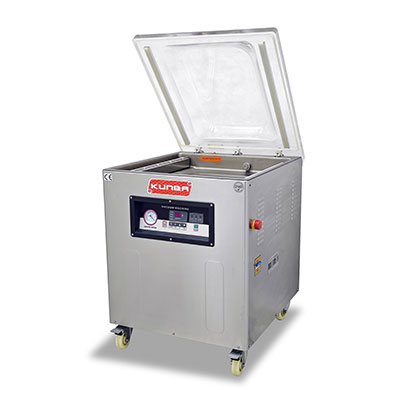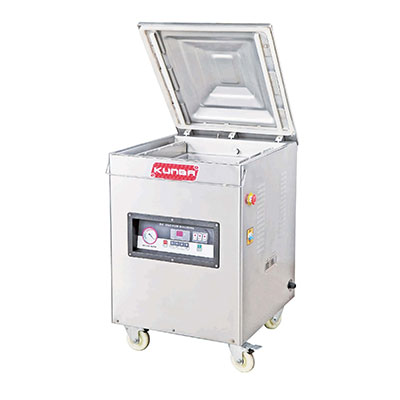
You just invested in a chamber vacuum packaging machine for your commercial kitchen or food processing facility. Six months later, you notice something troubling: hairline cracks forming in the plastic chamber. Or worse, rust spots creeping along the stainless steel weld joints.
Both plastic and stainless steel chambers have their own failure modes. Plastic chambers crack. Stainless steel chambers can dent and corrode. The real question is not which material is "better" in theory, but which one will hold up under your specific operating conditions.
This guide provides an objective, data-driven comparison of ABS plastic and stainless steel vacuum chambers in terms of impact resistance, corrosion resistance, cleanability, and real-world lifespan. You'll walk away with a clear decision framework for your next commercial investment.
Before diving into use cases, let‘s establish the baseline material properties that determine durability in a commercial packaging environment.
| Property | 304 Stainless Steel | ABS / Engineering Plastic |
|---|---|---|
| Impact Resistance | High, but denting is permanent and may compromise vacuum performance under high-force impacts. | Moderate–high with good toughness under normal use, but can crack under heavy impact or cyclic stress |
| Corrosion Resistance | Excellent against most food acids and alkalis; susceptible to chloride pitting above 50-60°C (seafood/salt brine environments) | Excellent against most acids, alkalis, and salts; vulnerable to certain organic solvents (acetone, ketones, esters) |
| Temperature Range | -40°C to 800°C (food processing range) | -25°C to 80°C (ABS resin typical range) |
| Cleanability | Excellent; can tolerate high-pressure spray, steam cleaning, and aggressive chemical sanitization. ers | Good; requires non-abrasive cleaning, neutral detergents recommended; avoid harsh solvents .ents |
| Outgassing Rate | Very low, suitable for high-vacuum environments | Higher than stainless steel; acceptable for general food vacuum packaging but not for ultra-high vacuum or sensitive lab applications |
| Weight | Heavy | Light |
| Cost | Higher | Lower |
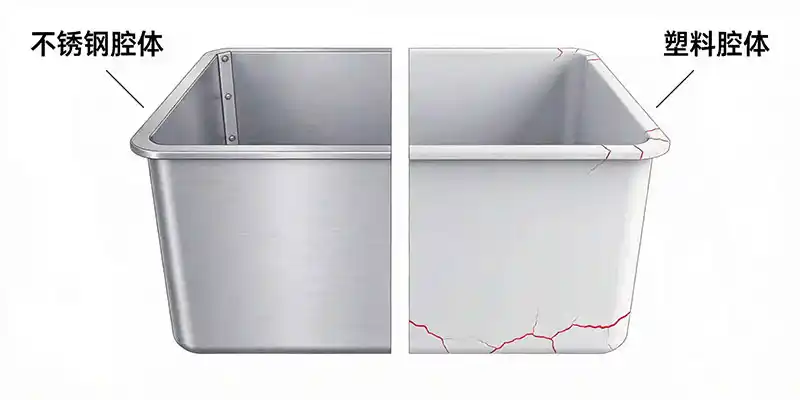
Stainless steel offers superior hardness, strength, and heat tolerance. ABS offers lighter weight, good corrosion resistance against most food acids and alkalis, and significant cost savings.
Let‘s look at three common commercial scenarios and how each material performs over time.
The Situation: A catering business moves its chamber machine between multiple kitchen stations or loads/unloads it from a delivery vehicle daily. The chamber inevitably bumps against counters, carts, and door frames.
Plastic Chamber Performance: ABS plastic has good toughness and impact resistance, suitable for many applications. For typical light-duty commercial bumps and daily handling, ABS holds up well. However, heavy impacts — such as dropping the entire machine off a worktable — can cause cracking.
Stainless Steel Performance: Stainless steel has excellent impact resistance and does not shatter or crack. However, it is susceptible to cosmetic and structural denting. A dented stainless chamber may compromise vacuum integrity, and dents cannot be "popped out" or repaired to their original shape. Vacuum pressure applies approximately 14.5 psi force across the chamber‘s entire surface area, which can exacerbate dent-related issues.
Verdict: For standard daily handling in fixed commercial locations, both materials perform well. If your operation involves extreme impact risks (frequent drops on concrete floors), plastic may crack while stainless steel may dent — neither scenario is desirable. Good operational handling practices are essential regardless of the material.
The Situation: A seafood processing facility runs 10-12 hours daily, vacuum-packing salted fish, shrimp in brine, and smoked salmon. The chamber is splashed with saltwater dozens of times per shift.
Plastic Chamber Performance: ABS plastic is inherently inert to salt. It will not rust, pit, or corrode in high-salt environments. This is arguably the strongest argument for plastic in marine or seafood applications.
Stainless Steel Performance: This is where stainless steel reveals its vulnerabilities. Standard 304 stainless steel is susceptible to pitting corrosion in chloride-rich (salt) environments, especially when temperatures exceed 50-60°C. The presence of chlorides may compromise the passive oxide layer and cause pitting of 304 stainless steel. Even 304 stainless steel can corrode at weld joints where the protective oxide layer is disrupted during fabrication. For seafood applications, 316 stainless steel (with 2-3% molybdenum added) provides significantly better resistance to salt pitting and crevice corrosion.
Verdict: ABS performs perfectly in salt environments. If you require stainless steel for other reasons, upgrade to 316 grade — but expect to pay a 15-25% premium over 304.
The Situation: A medical device packaging facility or pharmaceutical manufacturer requires autoclave sterilization of the vacuum chamber between production batches. The chamber must withstand repeated 121°C pressurized steam cycles.
Plastic Chamber Performance: ABS plastic has a maximum temperature limit of approximately 80°C. It cannot be placed in an autoclave or exposed to steam sterilization. Doing so will permanently deform or destroy the chamber.
Stainless Steel Performance: Stainless steel handles temperatures from cryogenic (-40°C) up to 800°C without degradation. It tolerates autoclave sterilization without issue. 316 stainless steel performs even more reliably than 304 during extended thermal cycling.
Verdict: If your operation requires any form of steam sterilization or high-temperature sanitation, stainless steel is the only viable option.
Meat and Seafood Processing (316 grade recommended): Frequent high-pressure washdowns, salt exposure, and rigorous sanitation protocols demand stainless construction.
Pharmaceutical and Laboratory Settings: High-temperature sterilization and chemical compatibility requirements make stainless steel mandatory.
High-Volume Industrial Operations: Floor-mounted, high-production machines require the structural strength and stability of stainless steel.
Food Facilities Using Aggressive Cleaners: Facilities that employ acidic or chlorine-based Clean-in-Place (CIP) systems benefit from the superior chemical resistance of 316 stainless steel.
Coffee Roasters, Spice Packagers, and Dry Goods: Minimal liquid contact and no aggressive sanitation requirements make ABS perfectly adequate.
Small Restaurants and Bakeries: Budget-conscious operations with light to moderate daily usage benefit from ABS's lower upfront cost and lighter weight.
Cafeterias and School Kitchens: The lighter weight is easier for staff to handle, and occasional bumps from carts will not crack the chamber.
Training Facilities and Educational Kitchens: Good impact resistance makes ABS more tolerant of the inevitable bumps and accidents during student operation.
For businesses that process both wet and dry products but cannot justify two machines, choose stainless steel with a 316 upgrade. It handles everything a commercial kitchen can throw at it.
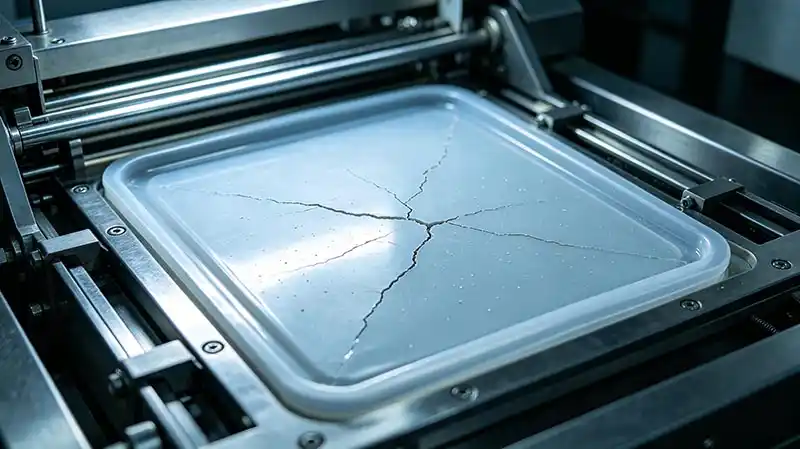
ABS plastic is susceptible to UV degradation. Over time — typically 12-24 months of direct sunlight exposure — the material becomes brittle and prone to cracking. If your packaging machine is positioned near a window, in an outdoor processing area, or under strong artificial UV lighting, the plastic chamber will age significantly faster.
Solution: Keep plastic chamber machines away from windows. If they must be placed near light sources, use UV-blocking window film or relocate the machine to a darker area.
While ABS has outstanding resistance to most acids and alkalis, it is vulnerable to certain organic solvents. Common commercial cleaning agents that may damage ABS include:
Acetone (found in some degreasers)
Methyl ethyl ketone (MEK)
Ester-based solvents
Solution: Use only neutral or mildly alkaline detergents for cleaning. Avoid aerosol degreasers or solvent-based cleaners unless you have confirmed compatibility with ABS.
Small cracks can sometimes be repaired using ABS-specific solvent cement, but the repair will always be weaker than the original material. The structural integrity of the repair under vacuum pressure is unpredictable. For any crack affecting vacuum performance, replacing the chamber or the entire machine is the safest course of action.
No repair should be attempted without confirming with the manufacturer that the repair method is approved and safe. For any application where food safety or human health is a concern, any cracked chamber should be replaced or the machine taken out of service.
Stainless steel is not a single material. For commercial food packaging equipment, two grades dominate:
304 Stainless Steel
18% chromium, 8% nickel
No molybdenum
Suitable for most food products, freshwater environments, and general food processing
Vulnerable to pitting corrosion in chloride (salt) environments above 50-60°C
Standard grade for most commercial kitchen equipment
Cost: baseline
316 Stainless Steel
16% chromium, 10% nickel, 2-3% molybdenum
The added molybdenum significantly improves resistance to pitting and crevice corrosion — especially in chloride, acidic, or high-temperature environments.
Required for seafood processing, pharmaceutical applications, high-acid products (citrus, tomatoes), and facilities using aggressive CIP chemicals
Cost: 15-25% premium over 304
For most dry food processing, 304 is sufficient. For any operation involving salt brine, cured seafood, acidic products, or aggressive cleaning protocols, upgrade to 316. The additional upfront cost is negligible compared to the cost of machine replacement caused by 304 corrosion.
Stainless Steel Chamber Machine: 15-20 years with consistent maintenance. The chamber itself will outlast the vacuum pump by a wide margin. Key replacement points are wear items — sealing bars, heating elements, pump oil, gaskets — not the chamber. Stainless steel is suitable for a wide range of demanding environments, offering durability and strength.
ABS Plastic Chamber Machine: 5-8 years,s depending on usage conditions. Plastic chambers degrade from UV exposure, chemical contact, and mechanical fatigue over time. After five years of daily commercial use, even well-maintained ABS chambers often develop microcracks and visible wear.
Small hairline cracks may be repairable with ABS solvent cement, but the repair will always be a weak point under repeated vacuum cycling. Cracks that compromise vacuum performance indicate the chamber or machine should be replaced. Do not attempt any repair without consulting the manufacturer's guidance — especially in commercial food applications where contamination risk is a concern.
Stainless steel has high dent resistance and will not dent or deform easily under normal daily commercial handling. It can dent under heavy impact — such as dropping a heavy cast-iron pot onto the chamber or striking the machine repeatedly with a steel cart. For typical commercial packaging operations, denting is rarely an issue.
No, from an operator safety perspective. Both materials are safe when used as designed. Plastic chambers are non-conductive (reducing electrical shock risk) and do not have sharp edges when cracked — though a cracked chamber should not be used. Stainless steel chambers offer greater fire resistance and containment for flammable contents. Neither material presents inherent safety hazards under normal use.
So, which material is more durable — stainless steel or plastic?
For long-term capital investment, choose stainless steel (ideally 316 grade for wet environments). It delivers 15-20 years of reliable service, tolerates high-temperature sterilization, and withstands the most demanding food processing environments. The higher upfront cost is offset by lower lifetime replacement costs and greater operational flexibility.
For budget-conscious startups, light-duty applications, and dry goods packaging, choose ABS plastic. It offers excellent corrosion resistance against food acids and alkalis, good impact resistance, significant cost savings, and lighter weight. For cafes, bakeries, and dry goods packers, ABS is a perfectly adequate and cost-effective solution.
The right decision depends on your specific environment. Assess your facility‘s cleaning protocols, product types, and expected usage volume before making a purchase. Your vacuum chamber will last longer — and your products will stay fresher — when you match the material to the application.
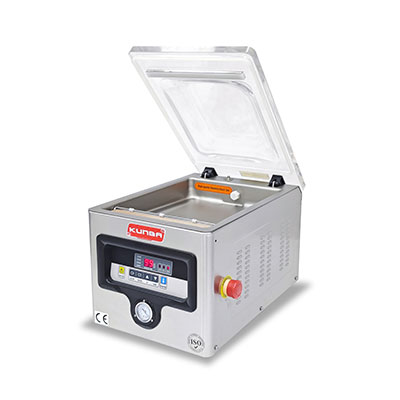
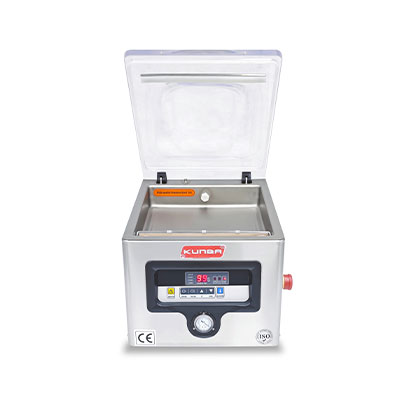
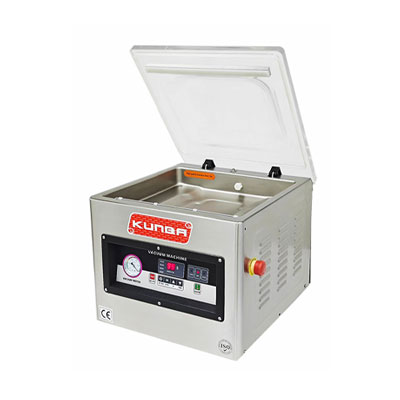
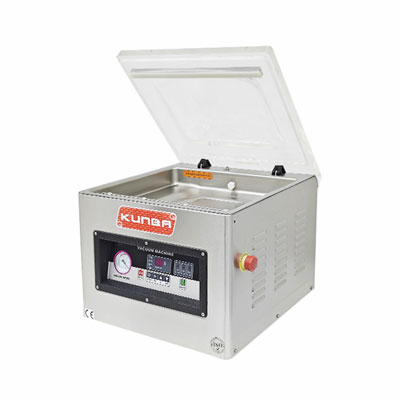
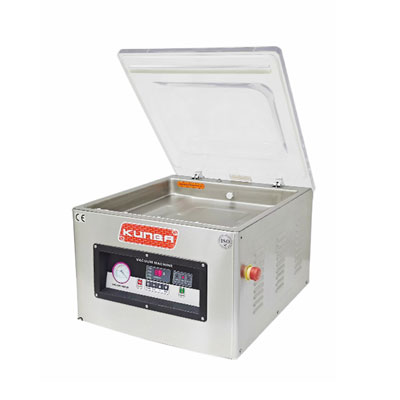
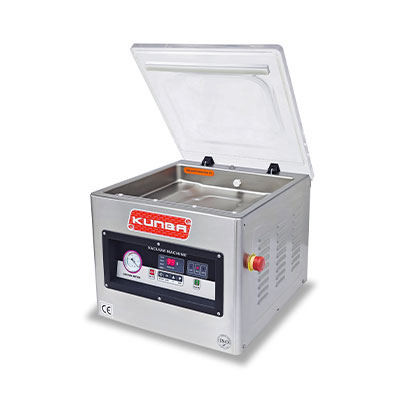
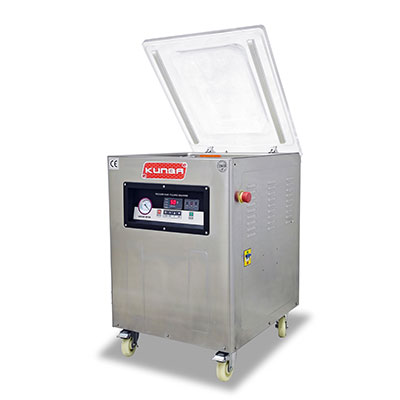
KUNBA offers full 304 stainless steel chamber machines with an optional 316 stainless steel upgrade for corrosive environments. Contact our team to discuss which configuration is right for your operation.
Note: The images in this article are for reference only.

GET A QUOTE

 中文
中文 English
 Français
 Español
 Português