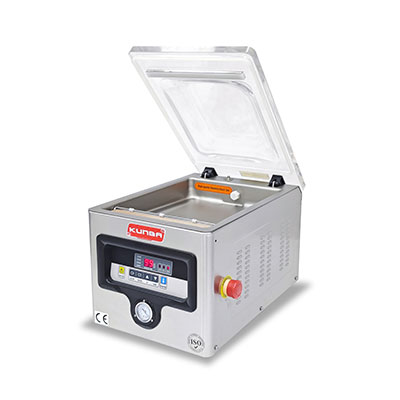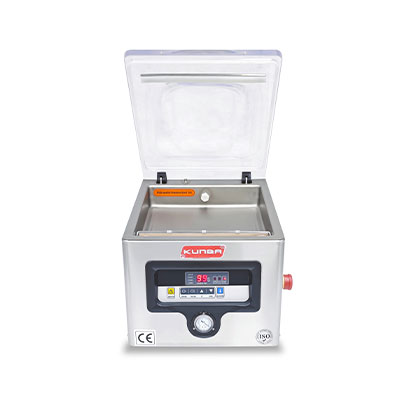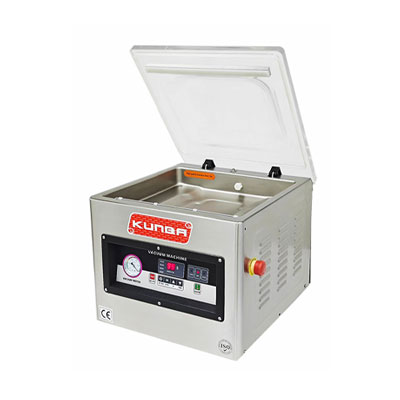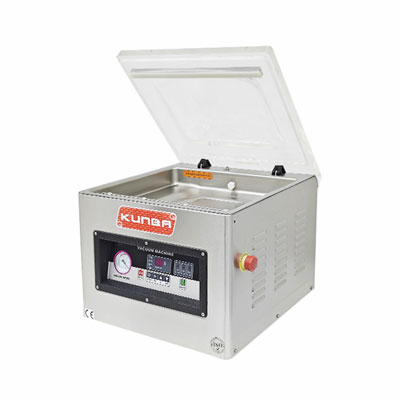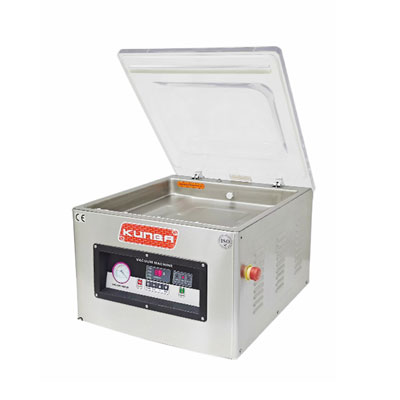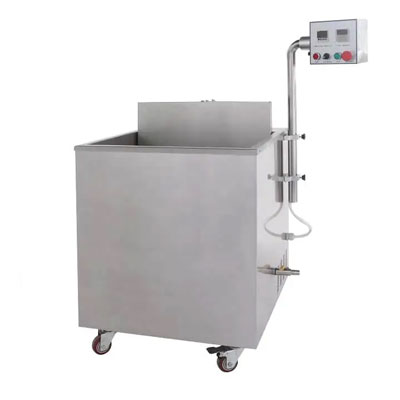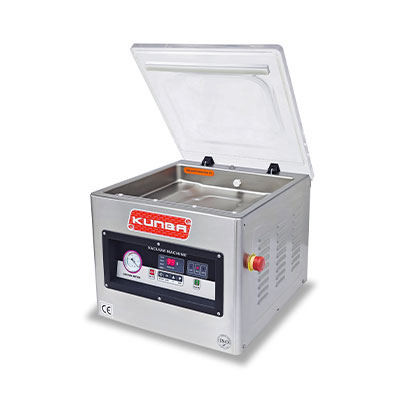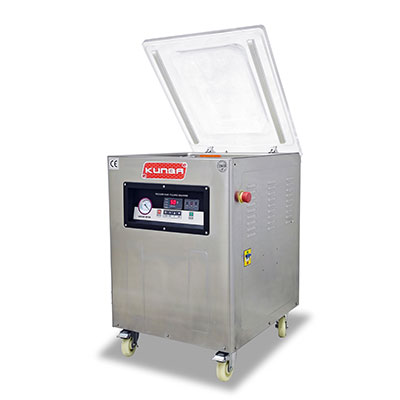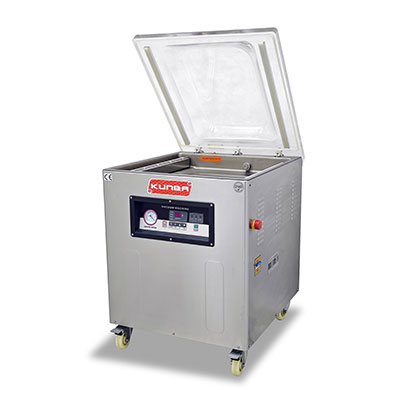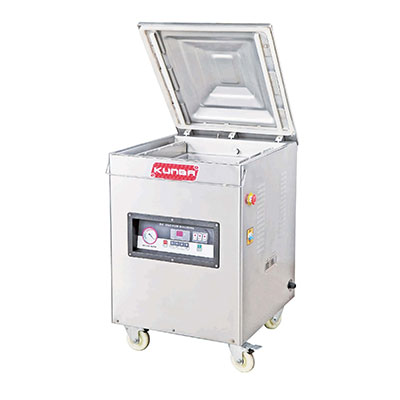
Nothing disrupts a production schedule faster than leaking meat packages. When you process beef or poultry daily, the last thing you need is juice seeping out of a failed seal, leading to freezer burn, cross-contamination, or a full product recall.
Standard vacuum sealers often fail in commercial meat environments. The culprit is usually myoglobin purge (the red liquid) or bone puncture. If your current setup struggles with wet, heavy, or sharp products, you don’t just need a new machine—you need the right vacuum packaging machine for commercial meat processing plant operations.
This guide provides a technical framework for selecting equipment based on your specific protein (red meat, poultry, jerky), daily throughput, and USDA/FDA sanitation requirements. By the end, you will know exactly how to match machine specs to your butchering or processing line.
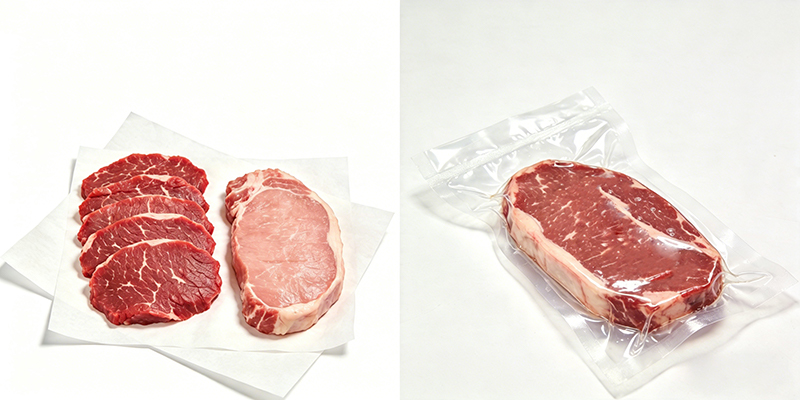
Before comparing vacuum chamber sizes, analyze your primary protein. Different meats destroy vacuum bags in different ways. Choosing a meat vacuum sealer for butchery requires matching the machine’s engineering to the product’s biology.
The Challenge: Myoglobin (purge) creates a slippery film that prevents sealing bars from reaching the necessary 180°C–200°C to melt the bag material. Furthermore, sharp T-bones or rib bones act like knives under atmospheric pressure.
The Requirement:
Chamber Vacuum Sealers Only: External suction sealers cannot handle liquid.
Double Seal Bars: Two sealing lines per cycle (a primary seal and a safety backup).
Gas Flush Option (MAP): For fresh red meat shipped to retail, you need Modified Atmosphere Packaging (80% O2 for red color retention, or 70% N2 / 30% CO2 for shelf life).
The Challenge: Salmonella and Campylobacter risks are high. Poultry skin is fragile; aggressive vacuum suction will deform the product, creating "angel wings" (folded, ugly skin) and leaking purge. The machine requires rigorous daily sanitation.
The Requirement:
100% Stainless Steel Construction (304 grade): To withstand chlorine or peracetic acid washing.
Gentle Vacuum Curve: Programmable slow evacuation to prevent crushing soft chicken breasts or whole birds.
Easy-drip Panels: Rounded interior corners to prevent biofilm accumulation.
The Challenge: Beef jerky vacuum packaging equipment faces a different enemy: dust. Dry marinade powders and smoke particles get sucked into the vacuum pump, killing it within months. Additionally, jerky is rigid; too much vacuum pressure turns the bag into a "rock," puncturing it.
The Requirement:
Anti-powder Filters: A removable dust filter between the chamber and the pump.
Precise Vacuum Control: Ability to stop vacuum at -0.8 bar (instead of -1.0 bar) for dry snacks.
Soft-air mode: To avoid crushing delicate jerky sticks.
You cannot run a 2,000 lb/day butchery on a $500 tabletop unit. The cycle time kills you. A single-chamber machine takes 30-45 seconds per cycle. A double-chamber cuts that to 15-20 seconds per cycle because one chamber vacuums while you load the other.
Use this selection matrix for your vacuum packaging machine for a commercial meat processing plant decision:
| Daily Throughput (Lbs) | Recommended Machine Type | Chamber Size (LxW) |
|---|---|---|
| < 500 | Tabletop Single Chamber | 12" x 14" |
| 500 – 2,000 | Floor-standing Single or Double Chamber | 16" x 20" |
| > 2,000 | Double Chamber or Belt (Conveyor) | 18" x 24" or Custom |
Pro Tip: If you process bone-in pork shoulders or whole briskets, add 4 inches to your length calculation. A 20" deep chamber fits a 16" brisket with room for the bag to lie flat.
General industrial vacuum sealers fail in meat plants because they ignore moisture. Here are four non-negotiable hardware features for a USDA-approved vacuum machine.
You must pressure wash your machine daily. If the control board or pump motor has an IP54 rating (splash resistant), water will ingress and cause short circuits.
IP65: Jet-proof from any direction.
IP66: Heavy seas/storm-proof (high-pressure washdown safe).
Look for: Sealed membrane keypads, not mechanical buttons.
Flat chambers pool myoglobin around the seal bar. As the bar heats, it boils the liquid, creating steam pockets that blow holes in the seal.
Solution: A 5-10 degree backward tilt. The juice runs to the rear of the chamber, away from the seal bar, and into a gutter that drains to a bucket.
Verify: Check if the chamber floor has drainage holes or a removable juice tray.
Single seal bars fail when meat juices contaminate the sealing wire.
Standard: One thick seal (8-10mm).
Meat-grade: Two parallel seals (2 x 6mm) spaced 5mm apart. If the first seal gets wet, the second seal catches it.
Crucial for: Bone-in hams and wet-aged beef.
For fresh meat shipped to grocery stores (shelf life >7 days), you need Gas Flush.
How it works: The machine vacuums to 99%, then injects a gas mix (e.g., N2/CO2), then seals.
Benefit: Prevents bag collapse (bag doesn't cling to the meat), reducing "corner leaks" and preserving red color.
If you supply restaurants, grocery chains, or export markets, your equipment must meet USDA sanitary design principles. A standard Chinese import machine will fail inspection. Here is how to verify a USDA-approved vacuum machine.
Requirement: All food contact surfaces (chamber, lid, seal bar housing) must be 304 stainless steel (or 316 for salt-heavy curing).
Rejection point: Galvanized steel legs or aluminum chambers. Aluminum corrodes in chlorine washdowns within 6 months.
Pathogens hide in crevices.
Bad: Intermittent tack welds or screw heads.
Good: Continuous, ground smooth, polished welds with a radius of at least 3mm in corners.
Check: Turn the machine over. Is the underside open (bad – collects debris) or sealed smooth?
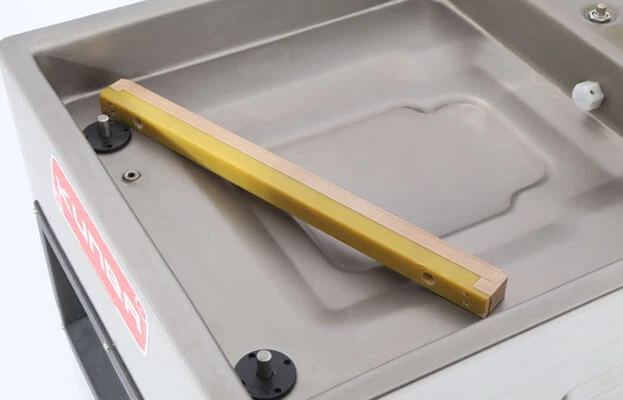
You must clean the seal bar and Teflon tape daily.
Requirement: Tool-less removal. The silicone pad (bottom) and seal bar (top) should pop out by hand.
Why: Dried meat juice on the Teflon tape causes sticking and tearing.
Never buy a vacuum packer for raw meat without testing your actual product. A demo with dry coffee beans is worthless.
Your testing checklist:
Bring 10 lbs of your worst-case product. For a beef plant: T-bone steaks with sharp bone edges. For a poultry plant: Bone-in thighs with skin.
Observe three things during the test:
Submersion test: Seal the bag, then submerge it in a water bucket. If bubbles stream out (usually from the corners), the machine's seal pressure is too low for your juice levels.
Angle leak: After sealing, hold the bag by the seal line. Does juice run down the inside of the bag to the bottom? If yes, the chamber wasn't tilted, and juice sat on the seal.
Bone puncture: Vacuum the sharpest bone. Does the bag shrink-wrap tightly over the point? If yes, you need a "bone guard" or a softer vacuum cycle.
Technically yes, but practically no. Raw meat purge contains high bacterial loads that cross-contaminate cooked, ready-to-eat (RTE) meats.
USDA rule: You must sanitize the entire chamber between raw and cooked runs.
Better solution: Dedicated machines. One color-coded red (raw), one blue (cooked).
Three solutions:
Bone guard strips: Self-adhesive foam pads placed on the bone tip.
Softer vacuum: Program a slower pump-down speed so the bag molds gently.
Double bagging: For heavy T-bones, use a thicker bag (4mil vs standard 3mil).
Based on commercial data for a $12,000 double-chamber machine processing 1,000 lbs/day:
Loss reduction: Reduces freezer burn waste from 8% to 1% (saving ~$7,000/year in beef).
Labor savings: Sealing manually with clip ties takes 20 minutes/100 lbs. Machine sealing takes 4 minutes.
ROI period: Typically 4-9 months for a plant running 5 days/week.
Selecting the right vacuum packaging machine for commercial meat processing plant operations is not about the priciest model. It is about matching three variables:
Chamber size to your largest bone-in cut.
Hygiene design (IP66, tilted, 304 stainless) to pass USDA audits.
Seal technology (double bar, gas flush) to handle myoglobin purge.
Do not guess. Do the water test. Bring your T-bones. And ensure the pump has enough CFM (Cubic Feet per Minute) to pull a full vacuum on wet loads.
Ready to eliminate leaky seals in your butchery?
Contact KUNBA for a customized meat packaging solution. We provide free product testing on your raw beef, poultry, or jerky—and deliver documented vacuum parameters for your specific protein. [Contact us today for a quote or a test report].

GET A QUOTE

 中文
中文 English
 Français
 Español
 Português