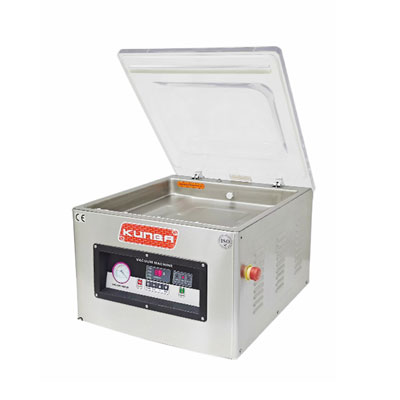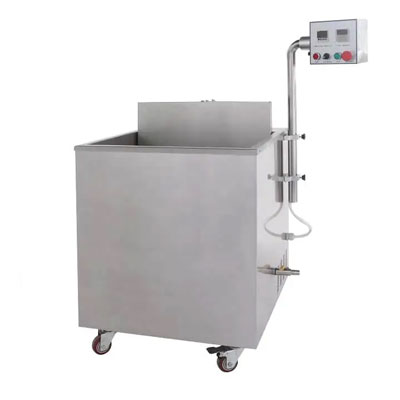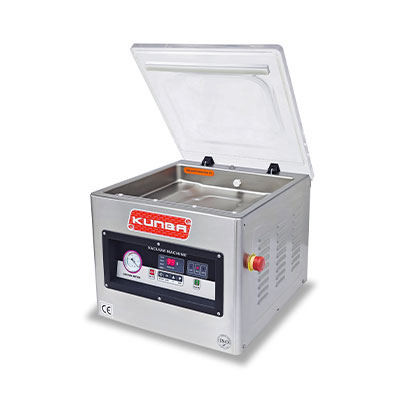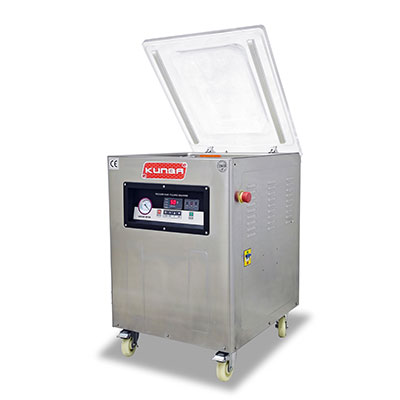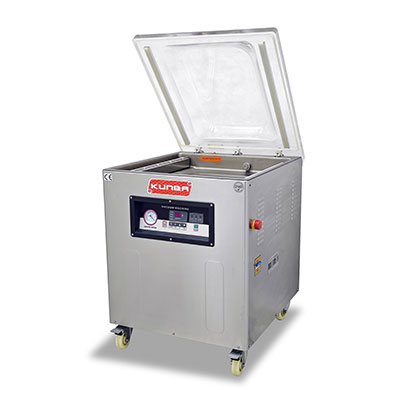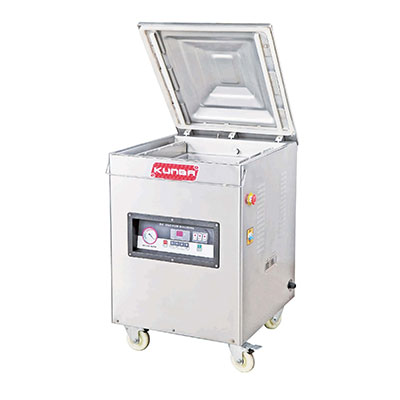
You’re not alone. Many food production managers watch employees stand idle, waiting for a single vacuum cycle to finish before they can load the next batch. That waiting time is lost money.
This guide will break down the real-world cycle times and daily throughput of single vs. double chamber vacuum packaging machines for business use. By the end, you’ll know exactly which machine matches your production forecast—without overpaying for capacity you don’t need or under-buying and regretting it six months later.
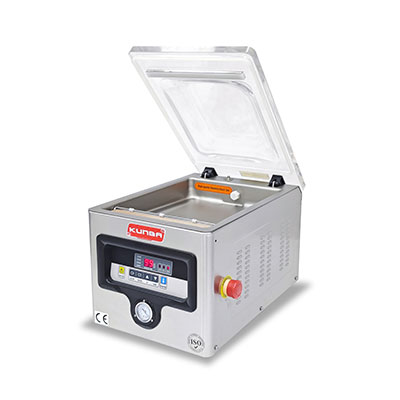
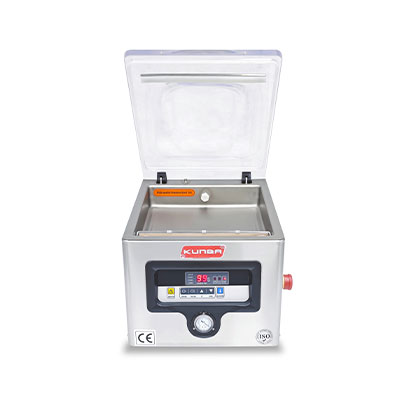
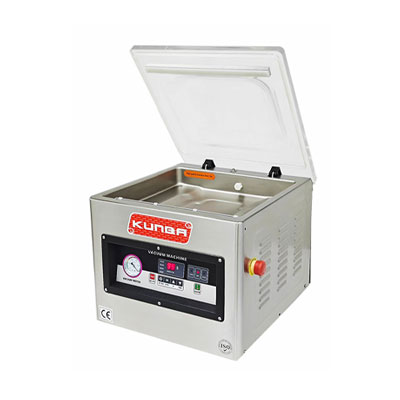
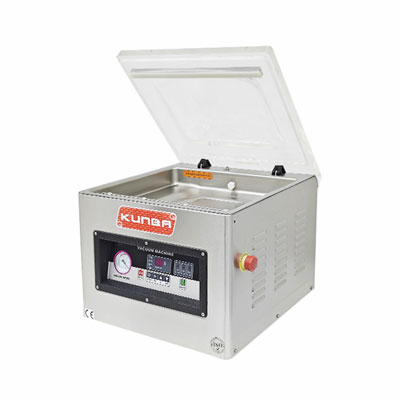
To compare capacity, we must first understand how each machine type uses time. The "work cycle" includes everything from the moment an operator starts sealing to when they begin the next load.
Load – Operator places bags into the chamber (5–10 seconds).
Start Cycle – Lid closes; machine evacuates air and heat-seals (typical: 20–40 seconds).
Unload – Cycle finishes; lid opens; operator removes sealed bags (5–10 seconds).
Repeat – Operator cannot load the next batch until step 3 is complete.
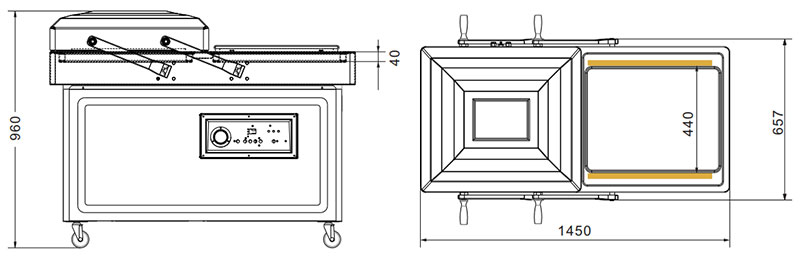
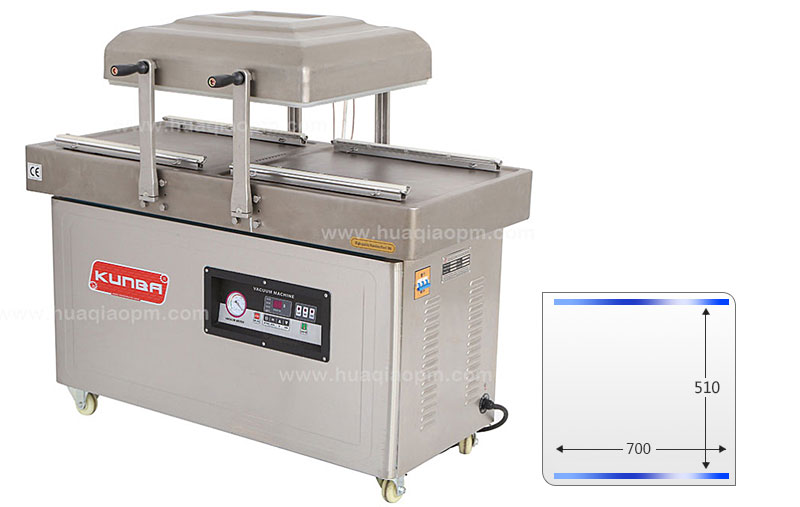
Double chamber machines are essentially two single chambers sharing one vacuum pump and control system, but the workflow is completely different:
Load Chamber A – Operator fills Chamber A.
Start Cycle on A – Chamber A begins vacuum/sealing.
While A is running – Operator loads Chamber B (zero machine idle time).
A finishes – Operator unloads A (5 sec), then immediately starts Chamber B.
While B runs – Operator loads Chamber A again.
Key insight: The double chamber vacuum sealer efficiency comes from eliminating the load/unload wait. The machine runs continuously, and the operator works continuously. No one waits.
Let’s put numbers on this. We’ll assume identical chamber size and a realistic 30-second vacuum + seal cycle (common for many meat, cheese, and dry goods applications).
| Machine Type | Single Cycle Time (incl. load/unload) | Cycles Per Hour | Hourly Output bags(Bags Per Cycle example 2) | 8-Hour Output (bags) |
| Single Chamber | 45 seconds (30 work + 15 load/unload) | 80 | 160 | 1,280 |
| Double Chamber | 30 seconds (continuous) | 120 | 240 | 1,920 |
If each bag contains a $10 product, the double chamber enables $8,000 more daily production value without adding staff.
Production managers often worry that a double chamber machine will eat up valuable floor space. The reality may surprise you.
A typical single chamber commercial unit occupies roughly 2–3 sq ft.
A double chamber machine of similar seal length occupies roughly 3–4 sq ft.
That’s only 20–30% more floor space for 50% more output. This is an exceptional space-to-throughput ROI. In facilities where every square foot costs money, the double chamber is often the more economical choice purely on space efficiency.
Despite the clear efficiency advantage of double chamber systems, single chamber machines remain the right choice for many businesses. Here’s when to stay single:
If your production consistently stays under 800 bags per 8-hour shift, a single chamber machine will handle it comfortably. You would pay for idle capacity with a double chamber.
Some products require 60–90 second cycles (e.g., liquid-containing foods, large solid muscle meats, or vacuum skin packaging). In these cases, the 15-second load/unload time becomes a smaller percentage of total cycle time. The efficiency gain from double chamber shrinks from 50% to perhaps 20–25%.
A quality commercial single chamber machine costs roughly $2,000–$4,000 USD. A double chamber of similar build quality starts around $5,000–$8,000 USD. If your production forecast shows no doubling within a year, the single chamber preserves capital for other needs.
When you’re ready to invest in high volume vacuum packaging equipment, don’t just look at price. These four features determine real-world uptime and operator satisfaction:
You’ll likely package different products (raw meat vs. cooked vs. dry goods). Each requires different vacuum times, pressures, and seal temperatures. A good panel stores 10–20 programs. Operators simply select "Product A" and press start. No guesswork, no inconsistent seals.
Continuous operation generates heat and vibration. Thin-gauge steel or plastic components will fail. Look for welded 304 stainless steel chambers and lid frames. For acidic or salty foods, 316 stainless is worth the upgrade.
Heating elements and Teflon tape wear out—it’s a consumable. On poorly designed machines, replacing them takes 30 minutes of disassembly. On operator-friendly designs, it’s a 2-minute job with no tools. Ask the supplier for a video of the replacement process before buying.
Manual lid lifting is fine for 50 cycles per day. At 200+ cycles per day, operator fatigue becomes real. Pneumatic (air-powered) or electric lid assist reduces strain and speeds up the load/unload motion by 1–2 seconds per cycle. Over an 8-hour shift, that adds up to nearly an hour of saved cumulative motion time.
No, not on standard models. Both chambers share the same vacuum pump and control logic. The settings (vacuum time, seal temperature, etc.) apply to whichever chamber is running. However, you can run different products sequentially: program for chicken (20 sec vacuum) on cycle 1, then switch to beef jerky (40 sec vacuum) on cycle 2. For true independent chamber control, you need a two-machine setup or specialized industrial equipment (very rare and expensive).
Slightly, but not significantly. Both have the same components: vacuum pump, seal bars, control board. The double chamber has additional seals and linkages for the second lid. Maintenance tasks (oil changes every 1,000 hours, cleaning seal bars, replacing Teflon tape) are identical in difficulty. The main difference is that a double chamber works harder (more cycles per day), so consumables wear out faster in calendar time—but not in cycles-to-failure.
With proper maintenance (regular oil changes, clean sealing surfaces, avoiding liquid overflow into the pump), a commercial-grade double chamber machine from a reputable manufacturer lasts 8–12 years in daily production use. Budget-grade units may last only 2–3 years. The vacuum pump is usually the first component to need replacement. Stainless steel chambers and frames often outlast the business itself.
Here’s the decision framework used by production managers who have made this choice before:
Your daily output is ≤800 bags
You have no plans to double production in the next 12 months
Your cycle time is unusually long (≥60 seconds) for technical reasons
Capital is extremely constrained (budget under $4,000)
Your daily output exceeds 1,200 bags
You expect to grow 50%+ in the next year
Your current single chamber machines are creating operator wait time
Floor space is expensive (cleanroom, cold storage)
You want the same labor to produce 50% more output
If your goal is growth, skip the intermediate step. Too many businesses buy a single chamber machine, outgrow it in 8 months, and then buy a double chamber—paying twice for packaging equipment. A double chamber machine isn't just higher capacity; it's a platform for scaling your food vacuum packing machine production rate without adding labor shifts.
Every product is different. Vacuum times vary. Bag sizes affect cycles per load. Let us help you match the exact machine to your numbers.
Contact KUNBA recommend chamber size and seal bar length, and show you ROI projections for single vs. double chamber options specific to your product line.

GET A QUOTE

 中文
中文 English
 Français
 Español
 Português